Thursday, April 26, 2018

Parshat Emor 5778 - Beyond The Basics

Parsha Paragraphs
Rabbi Naftali Kassorla

Parshat Emor 5778
Beyond The Basics
The D’var Torah for this week is dedicated in memory of:
ר׳ אלחנן יעקב בן מו״ח ר׳ שמואל פנחס ז״ל
If you are interested in sponsoring a D’var Torah in honor or in memory of someone, or for any occasion, please email: ParshaParagraphs@gmail.com

The Parsha tells us of the festival of Sukkot: You shall dwell in Sukkot for a seven day period; כל אזרח בישראל - every citizen in Israel shall sit in Sukkot” (Vayikra 23:42). By sitting in Sukkot, we commemorate the ענני הכבוד that accompanied the Jewish people in the wilderness.

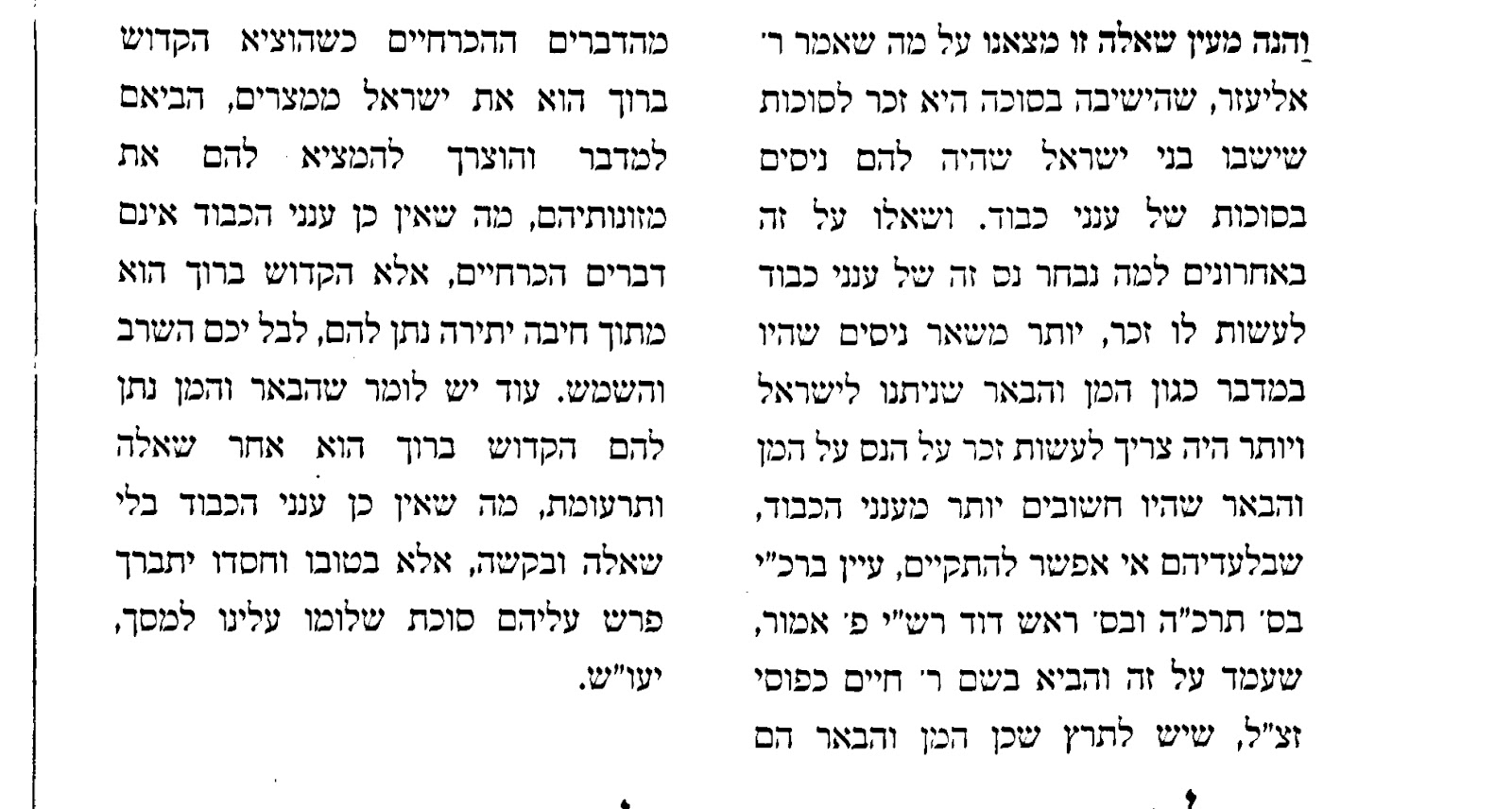
The Chid”a in Birkei Yosef (תרכ״ה) asks: Of all the things that G-d did for us in the desert, why do we commemorate the ענני הכבוד? Shouldn’t we make a remembrance of the מן – the miraculous, angelic food? Or the myriad of other miracles performed for us in the desert: the באר מרים that accompanied the Jewish people as they travelled, the clothing that G-d kept fresh, clean and the proper size for each person etc. What is uniquely special about the Clouds of Glory which G-d placed around the Jewish people that warrants their commemoration, as opposed to the other needs for which G-d provided?

The Chid”a* (ראש דוד פרשת אמור) answers in the name of the Chacham R’ Chaim Kaufusi that the Sukkah is a symbol of something much deeper than G-d providing for our needs. The other miracles provided for necessities, things that the Jews could not live without. A person cannot survive without food, drink or clothing, and of course G-d would not bring them to the desert without giving them these basic things. But for G-d to also protect the Jews with shelter from the sun and the wind showed a strong love and care for the deeper needs of the people. That extra show of love is what we commemorate.

To illustrate this idea: Picture a wife who sends her husband out to the store for the groceries, handing him a list of everything she needs to make Shabbat. Were the husband to robotically go down the list checking off each item, and bring home exactly what she asked for (no simple feat!) no one would complain or claim he hasn’t fulfilled his errand; on the contrary – he is a dutiful husband. But let's say he was going down the list, and sees that his wife did not write dish soap – something she hadn’t noticed they were running low on. Were the husband to return with this extra item, it would most definitely elicit tremendous love from the spouse. For he didn't go about providing for her apparent, expressed needs; rather he was sensitive to something deeper. His goal was to make sure she would have everything she needed, not just to fulfill his obligation and avoid complaints.

This is what Hashem did by providing shelter for the Jewish people. For had He not given them the ענני הכבוד (although they would have benefited greatly from it) no one would have complained, as there was no expectation for such a thing. It wouldn’t be as though G-d was withholding a major necessity, something for which the Jewish people did in fact complain about (e.g. food and water).

By providing us with the ענני הכבוד, Hashem showed that He does not just want to fulfill a responsibility to us as our Provider. Rather He loves us, He cares deeply about us, and He wants to fill any need we may have. Just like the husband, who knows he can easily get away with simply checking everything off his wife’s list. Instead he goes above and beyond the list and buys something that was never even requested, which he knows will be of great benefit to the one he loves.

This idea can give us further insight to the concept of הידור מצוה during Sukkot. Mimicking G-d, and reciprocating what He did for us, we do the mitzvot in a way that goes beyond the letter of the law. We don’t just buy any etrog; rather we look for the most beautiful one. We don’t just build a plain Sukkah, we go much further as we beautify it with pictures, decorations and more. Our approach to mitzvot isn’t to just check them off a list, dutifully doing exactly what was asked. Rather we perform them in a way that bespeaks of our attitude towards the mitzvah, one of חביבות, of love for the מצוה and for Hashem.

The Pele Yoetz (81) echoes this message for us:

הידור מצוה מורה על האהבה, כי העובד מיראה אינו מבקש אלא לצאת ידי חובה, אבל העובד מאהבה לפי רב החבה מדקדק בה שלא תחסר כל בה. והמוסיף להתנאות זה לו 
למופת ולאות שהוא אוהב את ה' בכל לבבו ובכל מאדו ומרבה בכבודו 
Hiddur Mitzvah bespeaks of the love [of G-d], for someone who serves [G-d] from fear only desires to fulfill his obligation. But one who serves with love, out of his tremendous affection, is careful that nothing is lacking [from his mitzvah]. And when he additionally beautifies [the mitzvah] it is his demonstration and sign that he loves G-d with all his heart and means, and this adds
to G-d’s honor

Perhaps this is also connected to why we have the extra day of Shemini Atzeret. This is when Hashem “begs” of us to stay “with Him” for one more day. G-d tells us: קשה עלי פרידכתם, עכבו עוד יום אחד – “Your departure is difficult for me, stay one more day” (Bamidbar 29:36). Shmini Atzeret as well shows that our relationship with G-d is not matter-of-fact. It involves a deep love, making it difficult for us to part.

On the special Yom Tov of Sukkot, Hashem expresses that He wants a relationship with us which goes beyond the basics. And all the more so now, as we approach Shavuot, commemorating the acceptance of the Torah on Mount Sinai, we are beckoned to re-accept the Torah, let us also re-examine our approach to Mitzvah observance, out of love and excitement, rather than simply just checking off our daily to-do list. 

Shabbat Shalom


*

Thursday, April 19, 2018

Parshat Acharei Mot - Kedoshim 5778: Not By Chance

Parsha Paragraphs
Rabbi Naftali Kassorla

Parshat Acharei Mot - Kedoshim 5778
Not By Chance
The D’var Torah for this week is dedicated in memory of:
ר׳ אלחנן יעקב בן מו״ח ר׳ שמואל פנחס ז״ל
If you are interested in sponsoring a D’var Torah in honor or in memory of someone, or for any occasion, please email: ParshaParagraphs@gmail.com

The parsha begins: “Hashem spoke to Moshe after the death of Aharon's two sons, when they approached before Hashem, and they died” (Vayikra 16:1). In Aharon's merit for accepting the decree without question, G-d introduces the Yom Kippur service. “בזאת יבא אהרן” – “With this shall Aharon enter [the holy of holies]” (ibid. 3).

Among the intricate and lengthy details of the Yom Kippur service, there is a compelling and mysterious aspect: the שעיר המשתלח, literally translated as “The sent he-goat.” The Kohen Gadol would set aside two he-goats, one on his left side and the other on his right. The Kohen would then stick both hands into a box filled with two lots. He would draw the lots, one in each hand. On one lot was written “לה׳”– this would be attached to one of the goats (the goat on the same side as the hand that drew this lot), and that goat would be brought as a קרבן חטאת (sin offering). The other lot read ״לעזאזל״ and was put on the other goat, which would be brought outside the city and pushed off a high cliff.

What is the significance of these lots? Seemingly it would be enough to set aside each one for a purpose, as with any other korban, i.e. one would be designated as a חטאת, and the other goat would be, by default, sent to Azazel. What is the purpose of labeling each goat separately, specifically through the process of a lottery?

There is a fascinating Gemara in Sanhedrin (43b) that can perhaps shed light on this question. After the miraculous destruction of Yericho, G-d placed a complete חרם (ban) on the spoils of war; no one was allowed to take anything from Yericho. In the next attempt at conquest, Yehoshua and the Nation fought the city of Ai, but were soundly beat back, losing thirty-six men in the battle. Yehoshua and the people were at a complete loss to understand why this tragedy befell the Nation, especially after such a powerful victory in Yericho. (See Yehoshua 7)

G-d comes to Yehoshua and tells him that someone in the camp has broken the חרם. Yehoshua asks G-d: “Who is it?” G-d responds “וכי דילטור אני (Am I a gossiper)?! Go, and make a גורל (lottery).” Yehoshua drew the lot, and it fell on Achan. Confronted with the results, Achan responded: “How can you find me guilty through lots? If I were to put you [Yehoshua] and Elazar Hakohen, two of the greatest of the generation, surely the lots would fall upon one of you as well!” Deeply bothered by this, Yehoshua responds: “Do not cast aspersions upon the lots, through which the land of Israel is destined to be apportioned!” Achan finally relents and admits his sin.

What was Achan’s argument here? And what about his argument upset Yehoshua so much?

The Maharsha, the famous commentator on the Talmud (ibid.), explains Achan’s defense as follows: “If I were to put only you [Yehoshua] and Elazar Hakohen in the box, of course it would fall on one of you.” Achan was claiming that there is no Providential authority to the lots; rather they are subject to “chance” – a מקרה בעלמא – just a random chance! And the biggest proof is: For even if he were to put two of the most saintly people, leaders of the generation, one of them would be found “guilty”, despite them being completely innocent. If they were the only options, then of course, statistically it would have to fall on at least one of them. Achan’s argument was that surely the lots are not a proof that he committed any wrongdoing.

But really this argument was a great disrespect to Yehoshua, for Achan was attacking a basic premise in Judaism: That G-d maintains an intimate and personal relationship with the Jewish people. Our Nation exists on a wholly different plane than the rest of the world. The Gemara says (Shabbat 156b) אין מזל לישראל, that we as a Nation are not governed by “chance” or statistics, rather we are tended to with love; guided and cared for directly by the One Above*. Therefore, if the lot fell on him, it was surely decided by G-d himself. (And if Yehoshua and Elazar were the only ones placed in there, G-d would find a way to make sure neither one comes out!)

To claim or suggest that something is just by chance or happenstance, removes the unique connection that G-d has bestowed upon the Jewish people, having set us aside from among the Nations of the world. And this is what Achan was attacking. Therefore, Yehoshua was deeply angered at this wanton disrespect for the lottery; he knew that nothing is by chance, and nothing that happens in this world is without G-d’s personal knowledge and direction.

This is why lots are an integral part of the Yom Kippur service in the Beit Hamikdash. They stand as symbols to the Jewish people that we are in the Hands of G-d, just as our fate and forgiveness on this holy day is decided by G-d alone. Not by chance or statistics, but rather a clear and guiding Master, and unto Him do we pray for our personal and National salvation. These lots would serve as a testament for all, that we are not cast into this world without Divine direction or care, and that no matter what the statistics say, there is always a chance that Hashem will do differently.

I once heard a remarkable story: A father of three was unfortunately stricken with a rare disease, an illness that carried with it a low percentage of survival. The family, obviously devastated to receive such news, met with their doctor to discuss a plan of action. The doctor, a non-Jew, led the family through what felt like a dizzying maze of options of experimental medications, risky surgeries and consultations with other doctors–experts in the field. But just as the family arose to leave, the doctor stopped the family: “One last thing I must tell you...you are Orthodox Jews, and you have a very powerful tool; you have prayer. I can't tell you how many times I've seen your Jews beat the odds. It's like you people are not subject to percentages! As much as I’m a non believer, and as hard as it is to admit, I've seen it too many times to ignore. Please don't forget to pray.” The family, strengthened with this “medical advice,” stormed the Heavens with their prayers. Thank G-d, their father went on to live for many years in full health, truly “beating the odds.”

This doctor had a front-row seat to this special nature of Klal Yisrael. No כח (power) other than G-d Himself controls our fate, and surely not statistics – a complete absence of power. This is a message we can learn from the גורלות of the Yom Kippur service, which we can carry through all year long.

Shabbat Shalom


* While the nature of השגחה פרטית, especially the concept of אין מזל לישראל, is subject to dispute, this is only regarding the individual, but in reference to the Nation as a whole there is an almost unanimous agreement among the commentators that G-d is personally involved in the collective fate of the Jewish People. Whether an individual is “on the level” to be personally watched over by G-d, is a matter of debate.
Furthermore as mentioned previously, אין מזל לישראל, does not necessarily mean that there is no guiding מזל to the Nation, or for an individual at all. For example, Rashi says (ibid. S”V אין מזל): דעל ידי תפילה וזכות משתנה מזלו לטובה - that through prayer and a persons merits, he can change his “fate.” This implies that there is a מזל, but it is not set in stone, rather it can be changed if one prays or is meritorious.
Regarding Achan's guilt, proven by the lotteries, one could ask: Why is this not considered purely a personal השגחה פרטית question, which is subject to dispute as previously mentioned? The answer to this is as follows: the lots were cast in order to discern the reason for why the Nation lost to Ai, which is ultimately a collective issue. The entire context and purpose of this episode in the Gemara in Sanhedrin is that the punishment for Achan’s sin was a carrying-out of collective punishment after crossing the Jordan, the time at which Klal Yisrael became subject to “כל ישראל ערבים זה בזה” – collective responsibility.

Parshat Tazria-Metzora 5778: A Life Apart

Parsha Paragraphs
Rabbi Naftali Kassorla

Parshat Tazria-Metzora 5778
A Life Apart
The D’var Torah for this week is dedicated in memory of:
 ר׳ אלחנן יעקב בן מו״ח ר׳ שמואל פנחס ז״ל
If you are interested in sponsoring a D’var Torah in honor or in memory of someone, or for any occasion, please email: ParshaParagraphs@gmail.com
This week’s parsha tells us of the Metzora – someone afflicted with Tzaraat – who must be put חוץ למחנה ישראל, sequestered from the Jews’ encampment.

Why is utter isolation the appropriate punishment for the Metzora?

The Gemara in Arachin (15b) gives an interesting explanation:

"אמר ריש לקיש מאי דכתיב (ויקרא יד-ב) זאת תהיה תורת המצורע זאת תהיה תורתו של מוציא שם רע"
“Reish Lakish said: What is stated ‘This shall be the law of the Metzora’ (Vayikra 14:2) – This shall be the law of one who slanders”

This affliction comes upon one who has actively slandered others. Thus, it seems befitting that the punishment for this person is alienation. By slandering others, he is misusing the gift of speech – a potential means of connection to others and building a cohesive society – in order to wreak havoc and bring destruction to humanity. Such a person shows that he is not fit to live among the rest of the people.

Unfortunately, we see too often that slander is used to “get ahead” in the workplace and in life. Man will “play” one person against another in an attempt to curry favor with both, thinking this will make him successful. But the Torah tells us that this behavior will ultimately lead to his downfall. The message here is clear: in the end, it is the slanderer who will be left isolated and alone.

Rav Chaim Shmuelevitz זצ״ל explains why Chazal (Nedarim 64b) includes the Metzora among the four who are considered dead even in life: 1. The Poor man; 2. The Childless; 3. The Blind Man; and 4. The Metzora. Each one of these categories of people are in some way or another excluded from “society.” The poor man cannot afford his basic necessities as others can, the barren are excluded from family activities, and the blind man cannot sense what others sense. In these ways each one is “removed” from the general public. The Metzora too, due to his own infractions, cannot partake of civil society. He is considered “dead,” not privy to live life (חיים) among others. 

I once heard from Rav Yecheskel Weinfeld שליט״א of Jerusalem, a beautiful idea. The word for life – חיים – is plural. This signifies to us that true life is not one of isolation. Rather it is to be shared with others. This dovetails beautifully with the message of the Metzora. He who is actively engaged in antisocial behaviors, using his speech to undercut and hurt others, is to be expelled from civilization – from “life.” 

Both the Kli Yakar and Rav Hirsch tell us that, in his isolation, the Metzora is now forced to reflect on his deficiencies and repent, so that he can once more become worthy of being a part of this Nation.

But while we antagonize the actions of the Metzora, the Torah does not allow us to forget his plight. The Gemara in Moed Katan (5a) quotes the verse “He [the Metzora] is to call out “Contaminated, Contaminated!” (ibid. 13:45). The Gemara explains that this proclamation is to serve the dual purpose of warning others of his affliction, so that they will not come to contamination, and also to: “inform the public of his anguish, so that they may pray for him.”

This Gemara has always fascinated me. The Metzora has done irrevocable damage to people’s lives, families and the general good of the community, to the extent that we disallow him any association with others. Seemingly, if there is a poster-child for a cancer on society, this person is it! When banishing him, shouldn’t we be saying: “Good riddance!”? Yet we see the complete opposite response is expected. The Torah demands of us to pray for him, that he should fix his ways and learn his lesson. I believe the Torah is communicating a deep and nuanced idea here: while we banish the Metzora for his crimes against humanity, through that process we cannot lose our humanity; we must still be able to empathize and care for everyone.

Speech is really an amazing thing. It has no physical characteristics (דבר שאין בו ממש), yet we see that it has the power to build or destroy, alienate or connect. We would be wise use the power of speech, not to put-down and belittle, but rather as a tool to create and empower. The common adage that everyone’s mother has told them at least once is: “If you have nothing nice to say, don’t say it.” But I want to add to that: If you have something nice to say, say it! Positive words and affirmations, which to us may be a mere afterthought, can be opportunities to change a person’s day, or even his life.

The Vilna Gaon has an amazing idea, quoted in his brother’s sefer Maalot HaTorah on the pasuk in Tehillim (1:3): והיה כעץ שתול על־פלגי מים אשר פריו יתן בעתו ועלהו לא־יבול...״ (He [The Righteous] is like a tree planted beside streams of water, which yields its fruit in season, whose leaves never fade). Chazal brings ועלהו לא־יבול (his leaves never fade) as the source for the concept that שאפילו שיחת תלמידי חכמים צריכה לימוד  – that even mundane conversations of Torah Scholars need to be gleaned for lessons (Sukkah 21b). The Gr”a asks: how in the world did Chazal see in these words that even their everyday conversations are worthwhile? The Gr”a answers that man is compared to a tree, as it says in Devarim (20:19) כי האדם עץ השדה, and the פרי, the fruit of man, is when he speaks about Torah topics. Just as the leaves on the tree protect the fruits, so too the leaves (ie. the mundane matters he discusses) protect the Torah. For the way one utilizes his mundane speech, reflects on the quality of the person’s Torah. Torah scholars, whose quality of Torah is so great, will have that reflected in their “everyday” discussions, and therefore there is much to be gained from them always.

The day presents itself with countless opportunities for communication and proper use of our words. Thus we too, each on our own level, can and should take advantage of these opportunities, to build closer connections with positive words.


Shabbat Shalom

Thursday, March 29, 2018

Pesach 5778 - Truth Preserved

צֵא וּלְמַד מַה בִּקֵּשׁ לָבָן הָאֲרַמִּי לַעֲשׂוֹת לְיַעֲקֹב אָבִינוּ: שֶׁפַּרְעֹה לֹא גָזַר אֶלָּא עַל הַזְּכָרִים, וְלָבָן בִּקֵּשׁ לַעֲקֹר אֶת-הַכֹּל. שֶׁנֶּאֱמַר: אֲרַמִּי אֹבֵד אָבִי, וַיֵּרֶד מִצְרַיְמָה וַיָּגָר שָׁם בִּמְתֵי מְעָט, וַיְהִי שָׁם לְגוֹי גָּדוֹל, עָצוּם וָרָב.

We are all familiar with this portion of the Haggadah known as ארמי אבד אבי (The Aramean [Lavan] sought to destroy my father). Here Lavan is being presented in contrast to Pharaoh. Lavan was worse than Pharoah, for Pharaoh only wanted to kill the boys, while Lavan tried to destroy Yaakov, and thus the future of the Jewish people.

This contrast is perplexing to the say the least. Firstly, in the פשוטו של מקרא (the plain understanding of the verses) nowhere do we find that Lavan intended to kill Yaakov, only that he swindled and tricked Yaakov endlessly. Furthermore, if anything, the person whom we do find intended to physically harm Yaakov, was Eisav who came upon Yaakov with 400 men to kill him. So why is Lavan singled out as the one who attempted to destroy Yaakov, and by proxy, the entire nation?

There are many answers to this question, an I would like to suggest a particular approach. As mentioned previously, Lavan was engaged in swindling behavior, constantly reneging on his previous agreements with Yaakov. Whether it was regarding the bride to whom Yaakov was to be married, or the payment he was to receive, Lavan was constantly acting in a duplicitous manner.

At a certain point, for the one who is being subjected to this abuse, it is only natural to become “street smart” and respond in kind, inevitably acting just as duplicitous as the one abusing him. Through this process of “standing up for himself,” he is in danger of having his essence altered and losing his תמימות (innocence), leaving himself irrevocably changed for the worse.

Yet Yaakov withstood one act of subterfuge after another, and came out of it whole, able to proclaim to Eisav עם לבן גרתי ותרי״ג מצות שמרתי - Though I lived with Lavan, I did not sway from the Torah's commandments (Bereishit 32:5). Yaakov preserved his trait of Truth despite the constant barrage of lies thrown at him.

This was perhaps the attempt to “destroy my father” - Yaakov, the symbol of pristine truthfulness, as it says in Micha (7:20) תתן אמת ליעקב. For if Yaakov had fallen prey to the pernicious attraction of retribution, he could have lost this midda of ישרות that is so tied in with attribute of Truth. And thus this trait would be lost to us as well. This would be עוקר the essence and spirit of our people, a Nation whose very existence bespeaks the ways of G-d, as it says in the Gemara Shabbat (55a) חותמו של הקב"ה אמת - The seal of G-d is truth.

Pharoah only desired to physically kill the Jews, thereby preventing them from joining his enemies. But Lavan desired to do much worse; he attempted to rot the inner core of the our Nation, rendering us hollow without any moral compass, ensuring the spiritual destruction for millennia to come. Lavan tried to destroy אֶת הַכֹּל, and if successful it truly would have been the destruction of everything.

So, as we go through the portion of Magid in the Haggadah, we mark the special trait of Yaakov and the essence of our people in stark opposition to the evil of Lavan. May we always remember who we are and the power we have ingrained in us against this evil.

Chag Kasher Ve’Sameach


Tuesday, March 13, 2018

Parshat Vayikra 5778 - The Great Communicator

Parsha Paragraphs
Rabbi Naftali Kassorla

Parshat Vayikra 5778
The Great Communicator
The D’var Torah for this week is dedicated in memory of:
ר׳ אלחנן יעקב בן מו״ח ר׳ שמואל פנחס ז״ל
If you are interested in sponsoring a D’var Torah in honor or in memory of someone, or for any occasion, please email: ParshaParagraphs@gmail.com

This week's parsha welcomes us to a new Sefer and the world of Korbanot. The parsha begins: וַיִּקְרָ֖א אֶל־מֹשֶׁ֑ה וַיְדַבֵּ֤ר יְהוָה֙ אֵלָ֔יו מֵאֹ֥הֶל מוֹעֵ֖ד לֵאמֹֽר - “He called out to Moshe, and Hashem spoke to him from the Tent of Meeting, saying” (Vayikra 1:1). Rashi explains that ויקרא, which appears superfluous, comes to teach us a rule – that every statement, saying, and command from G-d to Moshe is preceded with a קריאה (a “calling”) which is a language of endearment, the same language that the ministering angels use.

In communicating with this endearment, G-d does so only with Moshe. The rest of the nation could not hear. Meaning, that this was a prophecy to which only Moshe was privy. Rashi says: “The voice [of G-d] would go, and reach Moshe’s ears, and all of Israel could not hear it.” Rashi continues: “One might have thought that there was a ‘calling’ at breaks (i.e. the breaks in the text indicated by blank spaces).” One might have thought that a break indicates the beginning of a new and distinct prophecy which would be preceded with a new “calling”. The Torah teaches us that no, only when G-d actually speaks is it a new prophecy, but the breaks do not indicate a new prophecy. (Mizrachi, translated by Artscroll.)

If the breaks in the text did not serve the purpose of indicating a new and distinct prophecy, what purpose then did they serve? Rashi continues: “to give Moshe the time for contemplation of one parsha and the next, and between one topic to another. קל וחומר (all the more so) that time between subjects is necessary for a הדיוט (an ordinary person) who learns from another הדיוט.”

Rashi, quoting the Torat Kohanim (1:9), explains that G-d gave Moshe the time to contemplate and to understand the subject, and from the rule of kal vachomer we learn that ordinary people must also give and be given that time to contemplate.

However, what is the logic and reasoning behind this deduction? We can understand that while Moshe was the greatest prophet to have ever risen, and was master of all wisdoms, perhaps even he needed that time to contemplate when learning from G-d Himself. When learning the Torah from G-d, Whose wisdom cannot be fathomed, His essence cannot be grasped, and His grandiosity cannot be comprehended, of course Moshe would need the time to properly digest the concepts. But, who is to say that in the case of two “ordinary” people, where both are on the same level, that time must be given for the other to comprehend? What is the reasoning of the Torat Kohanim?

In truth we have to ask, what is the intention of the Torat Kohanim? Is it trying to tell us that due to the “lack” of the student we must give the רווח (space) to understand? Or perhaps it is telling us that when a teacher teaches, whether or not the student is lacking, he must be careful to teach in a way that the students have the ability to comprehend. If it is due to the lack on the part of the student, then our question stands. But if the Torat Kohanim is giving a lesson about the mark of a good teacher – that a teacher is lacking if he does not giving ample time for his students to comprehend – then we have our answer. From the fact that G-d gives Moshe – the most wise and humble of the prophets – the time to contemplate, we can learn that in our dealings, as “ordinary people” we must present our ideas in a way for them to be comprehended. It’s a lesson about the method of teaching, not the lack of the student.

This idea can be helpful in a myriad of aspects of teaching, including how loud one projects, how slowly one speaks, or a hundred other pedagogical methods which can aid the clarity of the message and comprehension of the student. But this is also a powerful lesson regarding the most basic underpinning of teaching: the teacher’s mindset and motivation for teaching.

A Rebbe is not there for himself; his objectives in teaching should be based solely on the comprehension of the students. And, barring other factors, if the student is not understanding, then he has failed his mission. For if they are not walking away with more clarity and understanding, what then is being accomplished?! That the Rebbe himself said a good shiur? That he felt honored? That he understood the subject?

I was once talking to someone who had a thirteen-year-old son in a “top tier” Yeshiva High School, and he was decrying the amount of sources and analytical approaches the teacher was “cramming” into the students. He felt his son was not understanding. This father, who himself is an accomplished scholar, told me that he was not the only one; other parents had also expressed concern that their children were not comprehending. When the parents finally mustered the strength to confront the Rebbe and express their concerns, he responded, “I teach the students on the level where I am holding. I was the top of my class, and I want them to witness true scholarship.”

When I heard this, I was blown away. How is it possible for someone, who has been entrusted with the holy task of חינוך (education) to think in such selfish terms? How could he get it so wrong? I believe the the truth is that this “Rebbe” is teaching for all the wrong reasons. He is not teaching with the aim of התבוננות and הבנה of his students, which would clearly warrant a tapering down of the level of the shiur. Rather he is involved in a nihilistic and self-serving pursuit under the guise of virtue, all while using the students as his footstool to raise up his own honor. I once heard from a very prominent Rabbi, that this type of teacher would be included in the prohibition of being המתכבד בקלון חברו - putting down others to raise up your own honor; for a teacher that neglects the progress of the students, while using them to honor himself, is the same as one who actively degrades them.

One of my most favorite quotes is in the name of Rabbi Yosef Dov Halevi Soloveitchik זצ״ל who would often remark that his favorite title was not Rav, Rosh Yeshiva, or Posek (halachic expert); rather it was מלמד, just a simple teacher, for G-d Himself is called teacher: המלמד תורה לעמו ישראל. Rabbi Soloveitchik felt that the highest calling, that which emulates G-d himself, is that of מלמד. And we learn from Hashem, in giving that “space” to Moshe to contemplate and comprehend, a demonstration of the proper way to accomplish the holiest of tasks – teaching Torah, with the holiest goal: to better the student.

Shabbat Shalom

Thursday, March 1, 2018

Parshat Ki Tisa 5778 - A Stiffnecked People

Parsha Paragraphs
Rabbi Naftali Kassorla

Parshat Ki Tisa 5778
A Stiffnecked People
The D’var Torah for this week is dedicated in memory of:
 ר׳ אלחנן יעקב בן מו״ח ר׳ שמואל פנחס ז״ל
If you are interested in sponsoring a D’var Torah in honor or in memory of someone, or for any occasion, please email: ParshaParagraphs@gmail.com


This week's parsha features one of the most famous and dark episodes in Jewish history: The sin of the Golden Calf, leaving a deep and lasting mark on the future of our Nation. G-d initially desires to wipe out the nation, but relents, after the pleading of Moshe on their
behalf: וַיֹּ֡אמֶר אִם־נָא֩ מָצָ֨אתִי חֵ֤ן בְּעֵינֶ֙יךָ֙ אֲדֹנָ֔י יֵֽלֶךְ־נָ֥א אֲדֹנָ֖י בְּקִרְבֵּ֑נוּ כִּ֤י עַם־קְשֵׁה־עֹ֙רֶף֙ ה֔וּא וְסָלַחְתָּ֛ לַעֲוֹנֵ֥נוּ וּלְחַטָּאתֵ֖נוּ וּנְחַלְתָּֽנוּ – If I have gained Your favor, O Lord, pray, let the Lord go in our midst, even though this is a stiffnecked people. Pardon our iniquity and our sin, and take us for Your own! (Shemot 34:9)

The Torah tells us that the Jewish people are an עם קשה עורף, commonly translated as “a stiff necked people.” However, while that may be the literal english translation, it falls short of the true meaning behind this deep description of our people.

The Malbim (ibid.) quotes the famous French Jewish Philosopher, Rav Levi Ben Gerson (commonly known as the Ralbag), who expounds upon this idea and offers a window into the the spiritual makeup of our People.

The Ralbag says that really, this attribute of the Jewish people is best understood as being skeptical and discerning. We are generally not willing to take anything at face value; rather we have an innate drive to question, investigate and understand things further.

However, says the Ralbag, once we have done a proper investigation and are “convinced,” our acceptance is iron-clad, and nothing will turn us away from the truth. Certainly no argument can convince us otherwise, but even more so – no threat of expulsion, no pogrom, no sword or gun barrel will ever take us away from the truth that we have ingrained in our collective bones. This is the “stiffneckedness” of the Jewish People. We stubbornly cling to what we have determined is the truth.

No other time was this was so clearly displayed as when Jews – faced with the stark reality of evil and depravity – were forced to march to the gas chambers. Knowing that they were walking to their deaths, they sang the traditional song of אני מאמין, declaring their unending faith and dedication to their G-d and their traditions. Such devotion can only come from the powerful knowledge that we intuit in the deepest recesses of our hearts. In the face of such evil, they showed that truth prevails.

While this middah can get us into trouble, and may cause us to be obstinate when we do wrong, nonetheless, Moshe argues on behalf of Klal Yisrael that Hashem should spare us in the very merit of this trait! This is an example of the complicated nature of personality traits; for sometimes the positive and negative can be bound together – forming the wondrous complexity of the human spirit.

I once heard someone speak derogatorily about a certain Torah Gadol of the past, a Gadol to whom we owe almost our entire Torah. He was critiquing this Rabbi for “being so stubborn to the extent that he thought everyone else was stubborn”! Aside from the obvious disrespect to the Gadol, this person totally missed the boat regarding the greatness of this particular Rosh Yeshiva. It was precisely because he was so stubborn that he was able to accomplish so much; This Rosh Yeshiva – facing a post-holocaust world that was apathetic to Torah scholarship – needed to be stubborn to stick to his principles to be able to imagine building and instilling the values that he received from his teachers to the next generation. The very critique was this Rabbi’s praise! (And while our own “stiffneckedness” and “stubbornness” can be utilized for the good, we certainly cannot let it disallow us from seeing the complexity and positive nature of another’s traits.)

May we be zoche to learn how to utilize the best of our talents and traits in the serving Hashem.

Shabbat Shalom


Related Posts Plugin for WordPress, Blogger...