Thursday, May 31, 2018

Parshat Beha’alotcha 5778 - To Stand Alone

Parsha Paragraphs

Rabbi Naftali Kassorla


Parshat Beha’alotcha 5778
To Stand Alone

The D’var Torah for this week is dedicated in honor of:
The 48th wedding anniversary of Dr. Allen and Sheila Gaisin.
By their children, Reuven and Shira Gaisin
May they continue to have many years of happiness and nachat from all their children and grandchildren.
If you are interested in sponsoring a D’var Torah in honor or in memory of someone, or for any occasion, please email: ParshaParagraphs@gmail.com

This week’s parsha features the official commandment to distinguish the Levi’im for their special, appointed task: קח את הלוים מתוך בני ישראל – Take the Levi’im from among the Children of Israel…(Bamidbar 8:5). They would serve as caretakers in the Mishkan.

The Midrash Tanchuma (8) makes a fascinating statement. As a general rule, G-d does not raise anyone to a position of authority (שררה) until He has “tested” them, and once they have passed and proved their mettle, G-d appoints them to their position.

The Midrash then cites the Tribe of Levi as a prime example of this rule. They proved their fealty when they did not abandon the Torah in Egypt. For when the Jews were enslaved and subjugated to intense labor, the Nation scorned the Mitzvot of Torah and circumcision, and they served idols. In contrast, the Levi’im were wholly righteous and kept the Torah. The Midrash continues: ולא עוד  – But not just that – when the Nation sinned with the Golden Calf, the Levi’im did not join in with them.

This Midrash has bothered me for years and I would like to share my thoughts on it.

First, I find the praise of the Levi’im for not abandoning Torah and Mitzvot in Egypt to be a bit perplexing. We already know from other places (Rashi, Shemot 5:4, Midrash Rabbah 5:17) that the Levi’im were not subject to the back-breaking slavery in Egypt. It stands to reason that the rest of the Nation, who was enslaved, would have been confronted with the almost insurmountable challenge of remaining strong in their Torah observance while being subjugated to intense labor.

But the Levi’im, who didn’t have the עול שיעבוד (the yoke of slavery) upon them, what “test” did they face? Their time was not fully occupied and they seemingly had the wherewithal to be able to keep the Torah, under no pressure. What is this heavy praise being heaped upon them, and why their observance a “proof” of their worthiness to take on positions of authority?

Second, if I were to think of an iron-clad proof of their faith, a pointed sign of the strength of Shevet Levi, it would be their refusal to join in with the עגל הזהב – The Golden Calf. This was the moment which set forth for all generations that Shevet Levi is set aside as a special class, for they stood strong and answered Moshe’s call of מי לה׳ אלי. Wouldn’t that episode be more demonstrative of Levi’s excellence? Yet fascinatingly, the Midrash seems to reference this amazing feat almost as secondary, a mere addition to the first episode. Seemingly, the specific episode of the Levi’s courage to not join with the rest of the people in serving the Egel should have been given as the first, prime example of strength!

I would like to suggest that in referencing the loyalty of Shevet Levi in Egypt, the Midrash is telling us something very particular about their nature and giving us a window into the true sign of its strength.

What do we see from the fact that Levi did not abandon the mitzvot in Egypt? For weren’t they already separate and different, in that they were not enslaved? But this is precisely the point. They did not succumb to the innate human desire to conform. While everyone else had lost their sense of self, Shevet Levi did not fall into the trap of moral license, justifying joining in with “the crowd.” When the public behaves a certain way, it is very easy and comfortable to conform to the people around you. Instead they retained the essence of their character, and refused to join in with the majority. 

The mere thought of standing alone and being at odds with the rest of society is difficult. Nobody likes to be disjointed from the larger group, as the human mind has a tendency1 to gravitate towards “groupthink” and conformity. When we are part of a larger group, it gives us the calming feeling of self-assurance and the perception that our lives fit into place. In contrast, the pressures of being separated from the majority has been shown to push people into a dark, deep existential angst which can lead to self-destruction. Thus, for someone to stand apart, they are subjecting themselves to an arduous array of emotional repercussions. But if they emerge whole from this process – this spiritual journey – they emerge as a new being. One that is untouchable by the winds of degeneracy and the manic whims of the majority.2 

With this in mind, we can now understand our second question. We asked, why does the Midrash seem to almost gloss over the fact that Shevet Levi did not join in with the עגל הזהב, which seemed to be a much stronger proof of their strength? 
I believe the answer is that their later refusal to join in serving the Egel was built off of the strong base of their long refusal to succumb to conformity. Throughout 210 years of slavery, this Shevet trained themselves to withstand immense pressure and the intense fear of standing alone. This, then, gave them the basis to answer Moshe’s call of מי לה׳ אלי.

This was Levi: the tribe that would be set aside to be the teachers of the Jewish people, as the verse says: יורו משפטיך ליעקב – They [Shevet Levi] shall teach Your laws to Jacob (Devarim 33:10). For though it was G-d Who set the Levi’im aside, the Levi’im already showed in Egypt that they were capable of doing it themselves!3 

Standing alone, as daunting as it may be, is a true display of spiritual strength, and is a clear measure of the readiness for leadership. To be a teacher, a leader, a person of authority, one cannot be subject to the whims and persuasions of public opinion. One must be strong in his ideals and steadfast in his decisions. And just as Levi proved themselves worthy, so too we should be given the strength to stand up and show our true mettle in trying times.

Shabbat Shalom

Thursday, May 24, 2018

Parshat Naso 5778 - The Painful Truth

Parsha Paragraphs
Rabbi Naftali Kassorla


Parshat Naso 5778
The Painful Truth
The D’var Torah for this week is dedicated in memory of:
גיסי ר׳ אלחנן יעקב בן מו״ח ר׳ שמואל פנחס זצ״ל
If you are interested in sponsoring a D’var Torah in honor or in memory of someone, or for any occasion, please email: ParshaParagraphs@gmail.com

This week's parsha tells of the Nesi’im, the Nazir and the Sotah.

After secluding herself with another man, having already been warned by her husband, the Sotah is brought to the Kohen. She must drink the מי מרים (bitter waters) which will test her: If she was unfaithful, the water causes her innards to burst. If she was truthful in denying the accusation, she lives.

The Mishna in Sotah (8b) tells us that when punishing the Sotah, G-d deals with her מידה כנגד מידה – commensurate to her actions. Just as she dressed to entice the man, her punishment is that her appearance is sullied. And just as she used her thigh for sin, her punishment is that her thigh is attacked first.

The Gemara points out what would seem to be an inconsistency in the text. The Torah tells us that when warning her of the punishment, the Kohen should state that the Sotah’s thigh will be stricken first, and afterwards her stomach. (Naturally water travels to the stomach before the thighs. This change in the natural order would fulfill the מידה כנגד מידה discussed in the Mishna.) Yet later, the verse indicates that “her belly shall swell, and her thigh shall fall away” (Bamidbar 5:27). The Gemara questions why the Kohen contradicts what the Torah says will happen, and gives a fascinating answer:

Abaye said in explanation: When the priest curses the woman, he first curses the thigh and then he curses the stomach, but when the bitter water evaluates her, it evaluates her along its way through the body. The water first enters the stomach and then reaches the thigh. The Gemara asks: But in the verse detailing the curse it is also written: “And this water that causes the curse shall go into your bowels, and will cause your belly to swell, and your thigh to fall away” (Numbers 5:22). The Gemara answers: That verse teaches that the priest notifies her that the stomach will be affected first and then the thigh, so that one not cast aspersions on the bitter water.

The pasuk which tells us that the stomach is hit first is describing the natural path of the water, as it travels the body and evaluates the woman’s actions. But the Kohen is meant to tell the woman exactly what part of her body will actually be punished first, and that is the thigh. The reason he needed to do so was שלא להוציא לעז על מי המרים. Rashi explains: For they [the onlookers] will say that since the water did not work in that order, the punishment [of death] was not caused by their [the Kohen and the bitter waters’] hands.” Due to an apparent slight change in the order of the punishment described by the Torah, people may have discounted the supernatural cause of the Sotah’s death.

This Gemara is absolutely amazing. Simply because the it seems that the waters didn’t go in the exact order which was described, despite the subsequent death of the Sotah, people will discredit the waters – and the miracle?! How is that possible? The onlookers of this process just witnessed a woman die instantly from drinking water mixed with ink. How could a person ever fathom that this death was anything but miraculous? How could one allow such a minor detail to derail him from the greater message?

We see in this Gemara a deep insight into the complexity of the human psyche. People naturally avoid criticism. We generally don’t like being told we are wrong, and if given the chance to defend ourselves, we may latch on to any detail or excuse to remove from us a sense of guilt or obligation. It can cause us to discount the truth – even a miraculous event – which happens right before our very eyes. 

Carl Jung (a 20th century psychoanalyst) termed this as “the Shadow” – the unconscious aspect of the personality which the conscious ego does not identify in itself. Because one tends to reject the least desirable aspects of one’s personality, the shadow, or the part which one is subconsciously covering, is largely negative.1

This inherent reflex to avoid contemplating the negative parts of ourselves, leads us to search for even the slightest inconsistency, so as to abdicate ourselves from the responsibility to admit fault or confront a painful reality. So fearful is the human psyche of itself, it actively turns away from the prospect of the blunt truth.

This is what the onlookers of the Sotah’s punishment would fall into: the refusal to engage with themselves on this deeper level, for fear of confronting uncomfortable truths. Rather they latched on to one small detail in order to ignore the whole.

It can be very difficult to get past this natural tendency to avoid criticism, and the searing pain that accompanies it. It requires a great deal of honesty and sincerity to know when we are ignoring the truth and getting distracted by these minor details, simply because we don’t want to admit we are wrong. But more importantly, it requires that we be confident enough in ourselves to understand that criticism is not a discounting of who we are, rather it is a means towards becoming better.

James A. Garfield, the 20th President of the United States once quipped: “The truth will set you free, but first it will make you miserable.” We need to keep in mind that this small bit of misery, just like a bitter pill, heals us like no other remedy.

If we can open our ears and listen to the messages that Hashem is sending us, as difficult as they may be to “swallow,” we can actually learn to respect ourselves more and derive confidence from the true heroism in confronting painful truths.

Shabbat Shalom


1 It's not a completely negative aspect, as there are also positive aspects that may remain hidden in one's shadow (especially in people with low self-esteem, anxieties etc.)

Thursday, May 17, 2018

Parshat Bamidbar 5778 - Standard Bearers

Parsha Paragraphs
Rabbi Naftali Kassorla

Parshat Bamidbar 5778
Standard Bearers
The D’var Torah for this week is dedicated in memory of:
לע״נ סבי ומורי נחום בן פנחס הלוי ז״ל
If you are interested in sponsoring a D’var Torah in honor or in memory of someone, or for any occasion, please email: ParshaParagraphs@gmail.com


With this week's Parsha we begin a new book in the Torah - Sefer Bamidbar. The central focus of this book is the laws and history of the Mishkan as the Jews travel through the desert. 

The Ramban points out that there are many interesting parallels between the description of the Mishkan and that of the revelation at Har Sinai. From this comparison we learn that the Mishkan, the Beit Hamikdash, and later the community synagogue are meant to serve as a reminder of the amazing experience the Jews had at Har Sinai. When the Torah was given, the Shechina (Divine Presence) came down and temporarily rested among the nation. In the Mishkan (as well as the Beit Hamikdash and the shul) the Shechinah rests permanently, and we have the opportunity to re-enter the experience we had at the giving of the Torah on a daily basis.

Perhaps we can take the Ramban's concept a little further. The beginning of the Parsha deals with the counting of the nation, yet Hashem specifically commands Moshe: "but you shall not count the tribe of Levi, and you shall not take a census of them among the children of Israel." 

At first glance this is very interesting – why does Hashem give the command not to count the tribe of Levi? Are they not part of the nation as well? Rashi explains that it was because this tribe chose not to sin with the golden calf at Har Sinai, and therefore they are not to be counted with the rest of the nation, but rather as a separate entity. We can derive from here that since the Leviim did not sin with the golden calf, they are considered to be of a distinct, higher standing.

Immediately after this commandment, Hashem directs Moshe to entrust the tribe of Levi with the assembling, disassembling and transporting of the Mishkan. One might ask why it was that the tribe of Levi was specifically chosen. In what were they meritorious, and what connection does it have with the Mishkan?

However, according to the aforementioned Ramban and Rashi, the connection between the Leviim and the work in the Mishkan becomes even clearer. As we know, the nation reached incredible heights at the revelation by Har Sinai. To have Hashem's divine presence revealed was the most seminal moment of holiness in this world and its power echoes through the generations to this very day. 

According to our tradition, the Nation reached the same level as Adam Harishon before the sin with the Tree of Knowledge, almost meriting the coming of Mashiach. Yet these hopes were dashed when the nation sinned with the golden calf, thus causing the nation to tumble from their lofty level. 

But one tribe remained steadfast in their devotion to Hashem; this was the tribe of Levi. This tribe, in withstanding from sinning, retained that holiness which was reached at the revelation.

Perhaps this is the reason that Levi was chosen. Since they were the only ones who did not sin at Har Sinai – and therefore the only ones who did not fall from their high level – it stands to reason that only they could do the service in the Mishkan, this "mini-Har Sinai." Levi would serve as the constant bearers and reminders of that divine revelation that was witnessed by all of Klal Yisrael at Har Sinai.

We see that in choosing Levi, Hashem is once again highlighting the connection between Har Sinai and the Mishkan, the Beit Hamikdash, and the Shul. We may often take for granted the level of holiness that we can achieve by entering our local shuls, and the proper respect with which they are to be treated.

With Shavuot upon us, it is quite appropriate that this should be our lesson carrying us in. For while we did not consciously experience the giving of the Torah personally, we have the incredible opportunity to return back to the level that was reached there, every time we enter a shul to daven or learn. If we truly take this idea to heart and behave in shul as though we are visiting the shechinah, we too can be on the level of the Leviim and merit to see the return of the Beit Hamikdash where we can once again do the Divine service, speedily in our days.

Shabbat Shalom and Chag Sameach

Thursday, May 3, 2018

Parshat Behar 5778 - Connecting Through Creating

Parsha Paragraphs
Rabbi Naftali Kassorla

Parshat Behar 5778
Connecting Through Creating  
The D’var Torah for this week is dedicated in memory of:
ר׳ אלחנן יעקב בן מו״ח ר׳ שמואל פנחס ז״ל
If you are interested in sponsoring a D’var Torah in honor or in memory of someone, or for any occasion, please email: ParshaParagraphs@gmail.com


This week's parsha ends off with an interesting juxtaposition:


לֹֽא־תַעֲשׂוּ לָכֶם אֱלִילִם וּפֶ֤סֶל וּמַצֵּבָה לֹֽא־תָקִ֣ימוּ לָכֶ֔ם וְאֶ֣בֶן מַשְׂכִּית 
לֹ֤א תִתְּנוּ בְּאַרְצְכֶם לְהִֽשְׁתַּחֲוֺת עָלֶ֑יהָ כִּי אֲנִי ה׳ אֱלֹקיכם…
אֶת־שַׁבְּתֹתַי תִּשְׁמֹרוּ וּמִקְדָּשִׁי תִּירָ֑אוּ אֲנִי ה׳׃

You shall not make idols for yourselves, or set up for yourselves 
carved images or pillars, or place figured stones in your land to 
worship upon, for I the Lord am your God…

You shall keep My sabbaths and venerate My sanctuary, 
Mine, the Lord’s. (Vayikra 26:1-2)

There two seemingly very different and separates subjects presented here. One is regarding the prohibition on making and worshiping idols, and the other is the mitzvah of keeping שבת and respecting the Holy Temple. Yet, their proximity to one another suggests that there is a deeper connection. What is that connection?

The Ralbag explains:
 זכר בזה המקום שמירת השבתות ויראת המקדש להעיר כי זה
.כלי מביא להישירנו על עבודת השם יתע' ולהרחיק מעבוד זולתו
Here the Ralbag tells us that there is something unique in particular about both שבת and the Mikdash in that they both serve as an antidote to the sin of idol worship. These mitzvot in particular are meant to have us serve Hashem as opposed to any other being or creation. 

But how exactly do they each accomplish this? 

Perhaps we can understand it as follows: By keeping שבת (refraining from acts of creation ie. Melacha) we are making a statement that it is not I who builds, rather it is G-d. This is in direct contrast to עבודה זרה, where Man literally creates an image, and serves that idol. For in truth, it is not the עבודה זרה that he worships; really it is himself whom he is serving – his own actions. (This is why the statement of כחי ועוצם ידי - “Through my hand and strength,” is such a terrible sin. It borders on idol worship to think that our own actions are the reason for our success.) When we keep שבת, we testify that G-d is the True Creator, that our feeble products and creations are nothing in comparison to G-d’s creations, and that without Him we cannot create a thing.

In light of this idea, how does the Mikdash actually counter Avodah Zarah? Isn’t the Mikdash the very essence of the people themselves building structures and serving with them? And while we don’t actually worship the objects built, we do revere them. How many verses does the Torah devote to recounting the building of the Mishkan!? Each vessel is meticulously described. It is completely possible that one involved in such a rigorous process of building, which required so much investment, could come to “worship” himself rather than the Being for Whom it was created. Thus, how can the Mikdash – its structure and vessels created by Man – be a protection against Avoda Zarah (i.e. self-worship)?

I would like to suggest that the Mikdash serves as the perfect counter-balance to the message of שבת. In being the cessation of Man’s “creating,” שבת reminds us that the fruit of our labor does not belong to us. But, through deeply inculcating this message, we are in danger of losing a fundamental value: that our actions are valuable – that G-d has granted Man the amazing power to create something unique and beautiful.

Idol worship is the corruption of Man’s natural and innate desire to create, where the product becomes an end unto itself, ultimately resulting in a nihilistic approach to worship. The Mikdash then also serves as an antidote to idol worship; it allows Man the proper space to create, and in a doing so, channel his G-dly ability to express and bring forth a product. 

The ability to create truly is a means to connect to the Almighty. Psychologist Dr. Jordan Peterson characterizes art and creativity as: “a window into the transcendent.” He explains that Man is inherently limited, yet by using his creative faculties, Man gives himself the ability to join with G-d in the covenant of the Divine.

This is the power of creativity; it is the expression of the deep language of the Soul, and it has the ability to connect us to G-d.

While שבת teaches us not to worship the creations of Man, nevertheless the Torah recognizes Man’s unique ability to be creative. And even more so, that his creations are important – important enough to be the ultimate place of service to G-d, the holiest place on earth, the Beit Hamikdash. However, this in turn is balanced by the message of שבת, so that those creations do not devolve into self-worship. And with this beautiful combination, we can use our abilities to serve Hashem in the correct way.

Shabbat Shalom

Thursday, April 26, 2018

Parshat Emor 5778 - Beyond The Basics

Parsha Paragraphs
Rabbi Naftali Kassorla

Parshat Emor 5778
Beyond The Basics
The D’var Torah for this week is dedicated in memory of:
ר׳ אלחנן יעקב בן מו״ח ר׳ שמואל פנחס ז״ל
If you are interested in sponsoring a D’var Torah in honor or in memory of someone, or for any occasion, please email: ParshaParagraphs@gmail.com

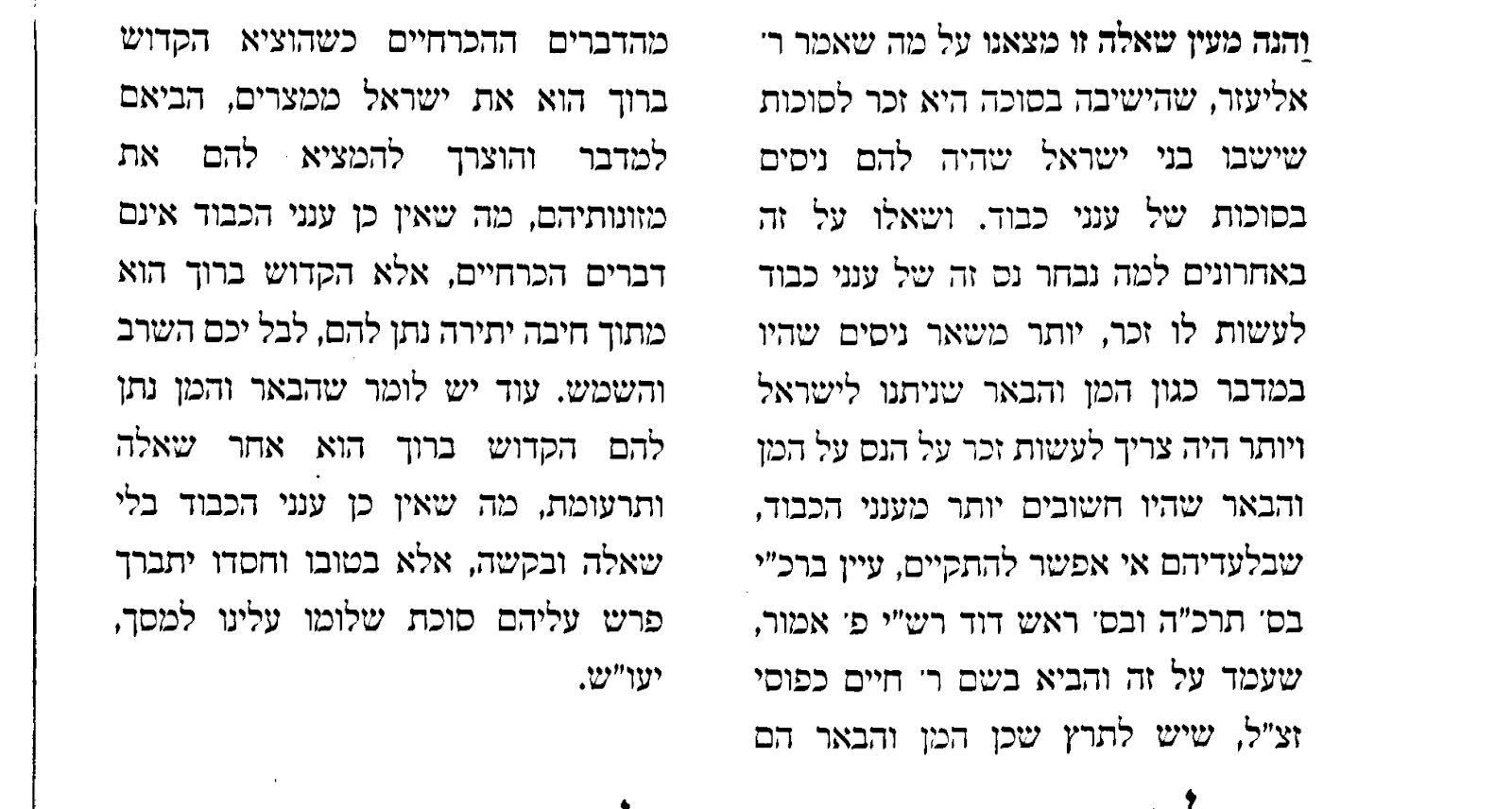
The Parsha tells us of the festival of Sukkot: You shall dwell in Sukkot for a seven day period; כל אזרח בישראל - every citizen in Israel shall sit in Sukkot” (Vayikra 23:42). By sitting in Sukkot, we commemorate the ענני הכבוד that accompanied the Jewish people in the wilderness.

The Chid”a in Birkei Yosef (תרכ״ה) asks: Of all the things that G-d did for us in the desert, why do we commemorate the ענני הכבוד? Shouldn’t we make a remembrance of the מן – the miraculous, angelic food? Or the myriad of other miracles performed for us in the desert: the באר מרים that accompanied the Jewish people as they travelled, the clothing that G-d kept fresh, clean and the proper size for each person etc. What is uniquely special about the Clouds of Glory which G-d placed around the Jewish people that warrants their commemoration, as opposed to the other needs for which G-d provided?

The Chid”a* (ראש דוד פרשת אמור) answers in the name of the Chacham R’ Chaim Kaufusi that the Sukkah is a symbol of something much deeper than G-d providing for our needs. The other miracles provided for necessities, things that the Jews could not live without. A person cannot survive without food, drink or clothing, and of course G-d would not bring them to the desert without giving them these basic things. But for G-d to also protect the Jews with shelter from the sun and the wind showed a strong love and care for the deeper needs of the people. That extra show of love is what we commemorate.

To illustrate this idea: Picture a wife who sends her husband out to the store for the groceries, handing him a list of everything she needs to make Shabbat. Were the husband to robotically go down the list checking off each item, and bring home exactly what she asked for (no simple feat!) no one would complain or claim he hasn’t fulfilled his errand; on the contrary – he is a dutiful husband. But let's say he was going down the list, and sees that his wife did not write dish soap – something she hadn’t noticed they were running low on. Were the husband to return with this extra item, it would most definitely elicit tremendous love from the spouse. For he didn't go about providing for her apparent, expressed needs; rather he was sensitive to something deeper. His goal was to make sure she would have everything she needed, not just to fulfill his obligation and avoid complaints.

This is what Hashem did by providing shelter for the Jewish people. For had He not given them the ענני הכבוד (although they would have benefited greatly from it) no one would have complained, as there was no expectation for such a thing. It wouldn’t be as though G-d was withholding a major necessity, something for which the Jewish people did in fact complain about (e.g. food and water).

By providing us with the ענני הכבוד, Hashem showed that He does not just want to fulfill a responsibility to us as our Provider. Rather He loves us, He cares deeply about us, and He wants to fill any need we may have. Just like the husband, who knows he can easily get away with simply checking everything off his wife’s list. Instead he goes above and beyond the list and buys something that was never even requested, which he knows will be of great benefit to the one he loves.

This idea can give us further insight to the concept of הידור מצוה during Sukkot. Mimicking G-d, and reciprocating what He did for us, we do the mitzvot in a way that goes beyond the letter of the law. We don’t just buy any etrog; rather we look for the most beautiful one. We don’t just build a plain Sukkah, we go much further as we beautify it with pictures, decorations and more. Our approach to mitzvot isn’t to just check them off a list, dutifully doing exactly what was asked. Rather we perform them in a way that bespeaks of our attitude towards the mitzvah, one of חביבות, of love for the מצוה and for Hashem.

The Pele Yoetz (81) echoes this message for us:

הידור מצוה מורה על האהבה, כי העובד מיראה אינו מבקש אלא לצאת ידי חובה, אבל העובד מאהבה לפי רב החבה מדקדק בה שלא תחסר כל בה. והמוסיף להתנאות זה לו 
למופת ולאות שהוא אוהב את ה' בכל לבבו ובכל מאדו ומרבה בכבודו 
Hiddur Mitzvah bespeaks of the love [of G-d], for someone who serves [G-d] from fear only desires to fulfill his obligation. But one who serves with love, out of his tremendous affection, is careful that nothing is lacking [from his mitzvah]. And when he additionally beautifies [the mitzvah] it is his demonstration and sign that he loves G-d with all his heart and means, and this adds
to G-d’s honor

Perhaps this is also connected to why we have the extra day of Shemini Atzeret. This is when Hashem “begs” of us to stay “with Him” for one more day. G-d tells us: קשה עלי פרידכתם, עכבו עוד יום אחד – “Your departure is difficult for me, stay one more day” (Bamidbar 29:36). Shmini Atzeret as well shows that our relationship with G-d is not matter-of-fact. It involves a deep love, making it difficult for us to part.

On the special Yom Tov of Sukkot, Hashem expresses that He wants a relationship with us which goes beyond the basics. And all the more so now, as we approach Shavuot, commemorating the acceptance of the Torah on Mount Sinai, we are beckoned to re-accept the Torah, let us also re-examine our approach to Mitzvah observance, out of love and excitement, rather than simply just checking off our daily to-do list. 

Shabbat Shalom


*


Thursday, April 19, 2018

Parshat Acharei Mot - Kedoshim 5778: Not By Chance

Parsha Paragraphs
Rabbi Naftali Kassorla

Parshat Acharei Mot - Kedoshim 5778
Not By Chance
The D’var Torah for this week is dedicated in memory of:
ר׳ אלחנן יעקב בן מו״ח ר׳ שמואל פנחס ז״ל
If you are interested in sponsoring a D’var Torah in honor or in memory of someone, or for any occasion, please email: ParshaParagraphs@gmail.com

The parsha begins: “Hashem spoke to Moshe after the death of Aharon's two sons, when they approached before Hashem, and they died” (Vayikra 16:1). In Aharon's merit for accepting the decree without question, G-d introduces the Yom Kippur service. “בזאת יבא אהרן” – “With this shall Aharon enter [the holy of holies]” (ibid. 3).

Among the intricate and lengthy details of the Yom Kippur service, there is a compelling and mysterious aspect: the שעיר המשתלח, literally translated as “The sent he-goat.” The Kohen Gadol would set aside two he-goats, one on his left side and the other on his right. The Kohen would then stick both hands into a box filled with two lots. He would draw the lots, one in each hand. On one lot was written “לה׳”– this would be attached to one of the goats (the goat on the same side as the hand that drew this lot), and that goat would be brought as a קרבן חטאת (sin offering). The other lot read ״לעזאזל״ and was put on the other goat, which would be brought outside the city and pushed off a high cliff.

What is the significance of these lots? Seemingly it would be enough to set aside each one for a purpose, as with any other korban, i.e. one would be designated as a חטאת, and the other goat would be, by default, sent to Azazel. What is the purpose of labeling each goat separately, specifically through the process of a lottery?

There is a fascinating Gemara in Sanhedrin (43b) that can perhaps shed light on this question. After the miraculous destruction of Yericho, G-d placed a complete חרם (ban) on the spoils of war; no one was allowed to take anything from Yericho. In the next attempt at conquest, Yehoshua and the Nation fought the city of Ai, but were soundly beat back, losing thirty-six men in the battle. Yehoshua and the people were at a complete loss to understand why this tragedy befell the Nation, especially after such a powerful victory in Yericho. (See Yehoshua 7)

G-d comes to Yehoshua and tells him that someone in the camp has broken the חרם. Yehoshua asks G-d: “Who is it?” G-d responds “וכי דילטור אני (Am I a gossiper)?! Go, and make a גורל (lottery).” Yehoshua drew the lot, and it fell on Achan. Confronted with the results, Achan responded: “How can you find me guilty through lots? If I were to put you [Yehoshua] and Elazar Hakohen, two of the greatest of the generation, surely the lots would fall upon one of you as well!” Deeply bothered by this, Yehoshua responds: “Do not cast aspersions upon the lots, through which the land of Israel is destined to be apportioned!” Achan finally relents and admits his sin.

What was Achan’s argument here? And what about his argument upset Yehoshua so much?

The Maharsha, the famous commentator on the Talmud (ibid.), explains Achan’s defense as follows: “If I were to put only you [Yehoshua] and Elazar Hakohen in the box, of course it would fall on one of you.” Achan was claiming that there is no Providential authority to the lots; rather they are subject to “chance” – a מקרה בעלמא – just a random chance! And the biggest proof is: For even if he were to put two of the most saintly people, leaders of the generation, one of them would be found “guilty”, despite them being completely innocent. If they were the only options, then of course, statistically it would have to fall on at least one of them. Achan’s argument was that surely the lots are not a proof that he committed any wrongdoing.

But really this argument was a great disrespect to Yehoshua, for Achan was attacking a basic premise in Judaism: That G-d maintains an intimate and personal relationship with the Jewish people. Our Nation exists on a wholly different plane than the rest of the world. The Gemara says (Shabbat 156b) אין מזל לישראל, that we as a Nation are not governed by “chance” or statistics, rather we are tended to with love; guided and cared for directly by the One Above*. Therefore, if the lot fell on him, it was surely decided by G-d himself. (And if Yehoshua and Elazar were the only ones placed in there, G-d would find a way to make sure neither one comes out!)

To claim or suggest that something is just by chance or happenstance, removes the unique connection that G-d has bestowed upon the Jewish people, having set us aside from among the Nations of the world. And this is what Achan was attacking. Therefore, Yehoshua was deeply angered at this wanton disrespect for the lottery; he knew that nothing is by chance, and nothing that happens in this world is without G-d’s personal knowledge and direction.

This is why lots are an integral part of the Yom Kippur service in the Beit Hamikdash. They stand as symbols to the Jewish people that we are in the Hands of G-d, just as our fate and forgiveness on this holy day is decided by G-d alone. Not by chance or statistics, but rather a clear and guiding Master, and unto Him do we pray for our personal and National salvation. These lots would serve as a testament for all, that we are not cast into this world without Divine direction or care, and that no matter what the statistics say, there is always a chance that Hashem will do differently.

I once heard a remarkable story: A father of three was unfortunately stricken with a rare disease, an illness that carried with it a low percentage of survival. The family, obviously devastated to receive such news, met with their doctor to discuss a plan of action. The doctor, a non-Jew, led the family through what felt like a dizzying maze of options of experimental medications, risky surgeries and consultations with other doctors–experts in the field. But just as the family arose to leave, the doctor stopped the family: “One last thing I must tell you...you are Orthodox Jews, and you have a very powerful tool; you have prayer. I can't tell you how many times I've seen your Jews beat the odds. It's like you people are not subject to percentages! As much as I’m a non believer, and as hard as it is to admit, I've seen it too many times to ignore. Please don't forget to pray.” The family, strengthened with this “medical advice,” stormed the Heavens with their prayers. Thank G-d, their father went on to live for many years in full health, truly “beating the odds.”

This doctor had a front-row seat to this special nature of Klal Yisrael. No כח (power) other than G-d Himself controls our fate, and surely not statistics – a complete absence of power. This is a message we can learn from the גורלות of the Yom Kippur service, which we can carry through all year long.

Shabbat Shalom


* While the nature of השגחה פרטית, especially the concept of אין מזל לישראל, is subject to dispute, this is only regarding the individual, but in reference to the Nation as a whole there is an almost unanimous agreement among the commentators that G-d is personally involved in the collective fate of the Jewish People. Whether an individual is “on the level” to be personally watched over by G-d, is a matter of debate.
Furthermore as mentioned previously, אין מזל לישראל, does not necessarily mean that there is no guiding מזל to the Nation, or for an individual at all. For example, Rashi says (ibid. S”V אין מזל): דעל ידי תפילה וזכות משתנה מזלו לטובה - that through prayer and a persons merits, he can change his “fate.” This implies that there is a מזל, but it is not set in stone, rather it can be changed if one prays or is meritorious.
Regarding Achan's guilt, proven by the lotteries, one could ask: Why is this not considered purely a personal השגחה פרטית question, which is subject to dispute as previously mentioned? The answer to this is as follows: the lots were cast in order to discern the reason for why the Nation lost to Ai, which is ultimately a collective issue. The entire context and purpose of this episode in the Gemara in Sanhedrin is that the punishment for Achan’s sin was a carrying-out of collective punishment after crossing the Jordan, the time at which Klal Yisrael became subject to “כל ישראל ערבים זה בזה” – collective responsibility.

Related Posts Plugin for WordPress, Blogger...